16 January 2012

Marilyn, David, and Me...and You

"This man beside us also has a hard fight with an unfavouring world, with strong temptations, with doubts and fears, with wounds of the past which have skinned over, but which smart when they are touched. It is a fact, however surprising. And when this occurs to us we are moved to deal kindly with him, to bid him be of good cheer, to let him understand that we are also fighting a battle; we are bound not to irritate him, nor press hardly upon him nor help his lower self." (John Watson, pseudonym Ian MacLaren, 1903)

I went to see My Week with Marilyn not knowing why I, like so many others, are still interested in her life--both her internal distress and her external success.

The external persona is now so coagulated, so concretized, with distinct physical landmarks and gestures of speech and body that a woman--or a man--can easily pass for "Marilyn" if she or he studies and mimics those landmarks and gestures. No actual physical resemblance is required: hair and makeup, speech and movement, these will suffice. It's entertaining to see people, from drag queens on P-Town streets, to celebrities in Vogue print layouts, to folks at costume parties, take on this costume of 50s woman-girl-ness. We know what it is as soon as we see it, and we mostly enjoy it. It is spectacle, something to marvel at--recreating those curves, the red mouth, the white hair and dress, the wide eyes and wispy voice. Finding just the right balance of knowing sexuality and innocent fun.

The movie, set while Monroe was already a movie star, but not quite yet at the peak of her stardom, reminded me that she had to put together those particular landmarks. Not quite from scratch--lots of female movie stars had already done a variation, falling on various points on the sex/fun continuum. And not alone--heaven knows several industries invested in this one femininity project, from the film industry to the cosmetics industry to the fashion industry. But still, she had to practice what to do with her eyes and lips and hair in front of a mirror. She had to develop that walk. She had to refine the balance of sex and fun, smart and dumb, in what she said and how she said it. You can see even the practiced movements and positions of her hands on herself, to move the viewer's attention this way and that. Before anyone could copy it, she had to (with much invested assistance) make it up, try it out, and refine it.

This transition has been much written about, from "Norma Jeane" to "Marilyn." It was a transition over years, but some say it was also done each work day, as she put on full makeup and costume.

Why does it still fascinate? I don't think it mesmerizes men solely because they want her. And I don't think it intrigues women solely because they want to be wanted like that.

I think it fascinates us simply because it is a huge, movie-screen version of the more modest project each of us engage in every day. Even if you're not female.

It is the huge project of creating a persona to present to the world. Trying out different clothing, ways of speaking, ways of moving and holding still. It is time consuming. Especially because most of us don't even have stylists. And we get invested in it. For some it is clothing and makeup and how to move; for others it is academic knowledge and how to write; for still others it is amassing money and the appearance of financial clout.

That said, some of us keep our persona as close to what we actually feel and know inside as we can. I think this is what is currently called "living authentically." But still--that sense of an individual self, and ego, a personality, is there, and the choices we have made in the past tend to cut us off from the full range of possibility in the present. So as authentic as we strive to be--to make the inside and the outside match--there is just too much inside to ever be fully represented on the outside.

My Interior: infinity. My Exterior: infinity limited by my filters of presentation, further constrained by your filters of perception.

Ditto for Your Interior and Your Exterior.

Of course, most of what we see on movie screens and in magazines is this kind of persona-writ-HUGE. It all fascinates, with its spectacle and the way it does the same job that we have to do every time we wake up, but on a much more detailed and careful scale. Because we don't admit that it's part of our job, part of our lives, but we pretty well all acknowledge that it's the whole point of the entertainment industries--carefully constructed fantasies, make-believes that we temporarily agree to believe. (It's this "temporary" that is sticky. For them and for us.)

Why does this one persona continue to shimmer, when many other personas that have been carefully developed have dimmed?

I think it is the way that the story keeps getting told of Norma Jeane being "under" the Marilyn persona, always feeling insecure, not good enough, unlovable, in need of protection, in danger of being abandoned...and wanting to be loved "for herself" rather than for her persona.

I think that's a pretty common thing. One of my favorite writers, David Foster Wallace, seemed to be haunted by similar demons. His persona was of the rational, intellectual, brilliant young man. His fear that he wasn't really brilliant seems to have kept him (I say this based on reading his fiction and nonfiction, as well as what other people have written about him) in a similar state of anxiety and depression.

Now, both these people had underlying mental illnesses that made them less stable and more prone to get stuck in the rut of continuing to develop and defend the persona even after recognizing that they want people to find out the "truth" about them and love them for that which is hidden rather than that which is put on display.

But that sounds pretty familiar to me, although it has never driven me to booze or pills. We all have to build a persona to present, even when we say we are not going to engage in that business (think teenage rebellion...yet the gaggles of teens rebelling at any given time wind up dressing and talking alike anyway...humans are such incorrigible imitators). And most of us, at one time or another, in modern life, start to fear that "the real me" is not being seen or loved, because all anyone bothers to see is the surface we have arranged for them.

This is where a crucial decision is made.

What do we do when we realize that there is a "gap" between how we feel inside and what we are presenting to others on the outside?

Do we tenaciously grip the persona, afraid of what will happen if we change it? This tends to lead to various dysfunctional behaviors, as the strain of defending and shoring up the persona gets more intense.

Or do we loosen our grip on who we think we are, how we show ourselves to the world, and take a chance at letting the Exterior more accurately reflect the Interior? (Or maybe sometimes the opposite--we may be able to "fake it 'til we make it," and work to grow the parts of the Interior that are emphasized in the Exterior, though I think this only works in small ways, when the two do not feel so very far apart.)

This is the work of yoga techniques: to recognize the ways in which the Interior is a bit different from the Exterior persona. It differs from most western psychological techniques in a few ways:
1. We may start with My Interior, but we soon realize it is Every Interior. That's why it's infinite. My Interior Is Not Actually Separate From Your Interior! (Is that terrifying or soothing right now?)
2. We work with both the body and the mind, and come to see these things as fully unified, regardless of which we started with--in hatha yoga, jnana yoga, raja yoga, bhakti yoga...and eventually we actually realize that the illusion (maya, samsara) IS the reality (Brahman, nirvana)
3. We don't believe the infinity of the Interior can ever be fully captured by the perception of the Exterior...unless perhaps this is what happens when we become Enlightened or fully Realized or Awakened, whatever you want to call it, but then it still depends upon everyone else becoming Enlightened, which is where the gurus and the bodhisattvas come in.
4. Thus, the Interior and the Exterior do not have to be fully reconciled--for they cannot be, until we are all more awake--but we do have to cultivate a constant awareness of the infinity of the Interior in order to not get caught up in the game of developing and defending the Exterior persona. (That game will continue, but we will always see it as a game, and rather than try to manipulate people into thinking it is not a game, we will encourage them to play, and remind them that it is play, even when the stakes seem serious.)

This last point is why I woke up and had to write about this. There are many scenes in the movie that show how an experienced, aging actor, Laurence Olivier, is angered and frustrated by Monroe showing up hours late, balking at his directorial suggestions, and flubbing lines continually. The movie suggests that her behavior is mostly due to her insecurity--it would take her hours to "prepare" the persona with the makeup, costumes, and gestures ready to execute, and even after all that she sometimes did not think she could do it. (The movie also intimates that some of this insecurity had already become a manipulative tool on her part--incorporating the fragility of "Norma Jeane" into the fixed, secure persona of "Marilyn" for sympathy.)

But we also see how Olivier fights his own demons of Exteriority-- he does not like how old he looks on the screen, particularly next to this spectacle of bubbly youth.

Yet instead of relating his own internal troubles to those of the woman he is frothing at the mouth about, he is further angered. If he can overcome his insecurities and show up on time with his lines, even though he is always afraid he will not live up to his persona in how he looks or how he performs, then she should, too, dang it. (Or bloody whatever.)

Sometimes we are hardest on those whose Exteriors are so shiny and bright, when we suspect that their Interiors are too much like our own.

Watch for this the next time you are in a yoga class. Or a grocery store. Or anywhere, really. Watch the way the mind takes in other people's Exteriors and "temporarily" believes they represent the whole Interior. And then decides that Interior/Exterior would just be so much better to live in than our own. Lucky dog.

Or so much worse. Poor thing.

That Interior already is you. Remember. Remember. Even as you play the game.

Tat tvam asi. Thou art that. You are That. See yourself in others, and others in you. Whether it's a glossy bubbly sexpot or a rapacious businessperson or a brilliant writer or an enlightened saint.

"This man beside us also has a hard fight with an unfavouring world, with strong temptations, with doubts and fears, with wounds of the past which have skinned over, but which smart when they are touched. It is a fact, however surprising. And when this occurs to us we are moved to deal kindly with him, to bid him be of good cheer, to let him understand that we are also fighting a battle; we are bound not to irritate him, nor press hardly upon him nor help his lower self." (John Watson, pseudonym Ian MacLaren, 1903)
04 January 2012

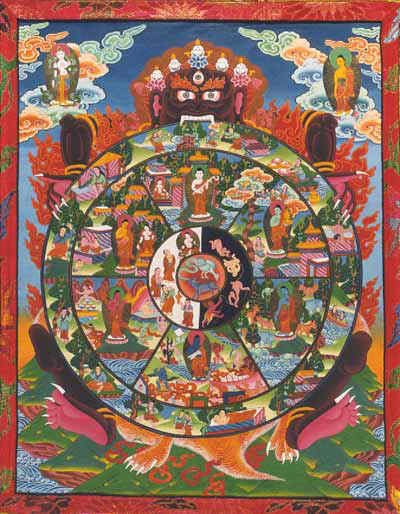
Visitors in the guest house; spokes on the Wheel of Life


The Wheel of Life (Bhavachakra) is a diagram that portrays the six realms of being. Here, the realm of the Devas is shown at the top, followed clockwise by the realms of the Asuras, the Pretas, Naraka, Animals, and Humans. Note that the Buddha is present in every one of these realms.

Buddhist cosmology posits these six realms as worlds that we are born into. As in many eastern worldviews, there is an essential element of each of us that travels from body to body, transmigrating or reincarnating through many lifetimes. Each time we take on a new body, we are born into one of these six worlds, and when we die, we are reborn into the same or a different world, depending on how much good and bad we have wrought through our actions, words, and thoughts.

Stay with me here, because I am not a believer in reincarnation, but there’s something really useful buried in this model of the Wheel of Life…so first, a brief description of each realm on the Wheel.

The Six Realms
Deva-gati
Asura-gati
Preta-gati
Naraka-gati
Tiryagyoni-gati
Manusya-gati

Deva-gati: realm of blissful beings
These beings are godlike, with wealth, power, long life, and happiness. But they are full of pride and self-satisfaction, and they are blind to the suffering of others, so no compassion or wisdom develops, and thus they do not extend themselves to others. They will be reborn to another realm. Doing good got them to this pleasant place, but they cannot free themselves from the wheel because they are no longer doing good for others.

Asura-gati: realm of the fallen gods
These demi-gods are full of envy and jealousy, because they can see the devas and wish to be in that realm. Since they want to be superior, they belittle others. They live in a more pleasurable situation than humans, but their envy and jealousy keeps them riled up. They got here by intending to do good in the past, but winding up doing harm to others.

Preta-gati: realm of hungry ghosts
These beings are depicted with huge empty stomachs, but pinhole mouths and skinny necks. They are perpetually hungry and thirsty, but cannot ever satisfy those cravings. This is the realm of craving, hunger, addiction, obsession, compulsion.

Naraka-gati: Hell realm
This is the most terrible of the realms. These creatures are angry, aggressive, driving away any who show love or compassion, seeking only other hell beings’ company. The only way out is time—they have planted karmic seeds by hurting others, and those seeds must bear terrible fruit for them to experience, and then they can be reborn to another realm.

Tiryagyoni-gati: animal realm
These creatures are ignorant, prejudiced, and complacent. It is not that they do not know, it is that they mis-know, they are incorrect in their thinking and content to remain that way. They are mostly concerned with avoiding discomfort and have no interest in understanding better, seeing more clearly, or doing good.

Manusya-gati: human realm
This is the only realm from which escape from the wheel of samsara is possible. Enlightenment is at hand…but only a few awaken to it. It is characterized by doubt, desire, but also inquiry and reflection. YOU SEE YOU ARE IMPERFECT, YET YOU DO THE RIGHT THING ANYWAY. You can see others’ suffering and respond with compassion, accruing great karma—which takes so long in any other realm. It is from this realm that you have a chance to jump off the wheel of habit, of doing the same thing over and over, of creating suffering in yourself.

Imagine you grow up hearing of these realms as worlds you inhabit over lifetimes. At the end of each life, your karmic accounting is done and according to its results, you are kicked into one of these realms to work out some more of your s**t. Very useful story for your society, which keeps you working to do good, yes? Pretty useful for you, too, as doing good will help you in the present moment, anyway.

Now imagine you find a teacher who tells you that, in fact, in each moment we are in one of these realms, and in fact, the wheel is constantly turning. These realms are a model for our emotional states as they shift and change over minutes and hours. And we put ourselves there, no one else does it for us. Moment by moment, we make ourselves blissful, envious, endlessly craving, angry, ignorant, doubtful. We do it in the way that we react to what is happening here and now. And in this moment—not in our next lifetime—we have opportunities to transmigrate into a different realm, by changing our response to how things are.

It is hard, to be sure, because our conditioning keeps us doing/saying/thinking the same things. But we always have a chance to change the realm we are in…and when we are in the human realm, of doubt, desire, inquiry, reflection…that is when we have a chance to let go of the whole darn cycle altogether. A chance to stop reacting and just stay aware. Each time we loosen the grip of samsara (conditioning) on our thoughts/words/actions, and perceive a new way of being, we are closer to freedom. It doesn’t take lifetimes. The moment is now.

I love this esoteric interpretation of the Wheel of Life. It doesn’t discount that it may, in fact, take more than one lifetime to really do this work (which I also agree with; I’m just not sure that we’ll get that next lifetime), yet it emphasizes that it starts right NOW. And big things can happen right now.

When the person at work or at home does something that arouses anger, or prompts a feeling of superiority, or even makes me feel happy because of my external circumstances...that's not a bad thing. (Remember, the Buddha is present in each realm!) But can I see that I have put myself into this realm of Hell, or of the Asuras, or of the Devas? Can the dramatization of the Wheel of Life help me find a little distance from the play of emotions on this stage?

We can change the ruts that our wheels have gotten stuck in, gradually creating new paths, and eventually roaming free of roads, paths, and ruts at all. And sometimes our wheels take a big jump off the beaten track! But most often, we have to work at moving this way and that, slowly nudging ourselves into new territory. New ways of moving the body, softening the heart, opening the mind.

Krishnamurti reminds us: “Enlightenment is an accident. But we can do certain things to make ourselves accident-prone.”

You know what those things are. Back to the mat.

(And doesn’t this kind of interpretation make you wonder about western cosmologies and metaphysical stories? The ones with equally unlikely chances at being literally correct, yet ripe with metaphorical possibilities?)

The Guest House

Being human is like a guest house.
Each morning a new arrival.
A joy, a depression, a meanness,
some momentary awareness
comes as an unexpected visitor.

Welcome and entertain them all!

Even if they're a crowd of sorrows,
who violently sweep your house
empty of its furniture,
still treat each guest honorably.

He may be clearing you out for
some new delight.

The dark thought, the shame,
the malice,
meet them at the door laughing,
and invite them in.

Be grateful for whoever comes,
because each has been sent
as a guide from beyond.

--Rumi

When you practice today, watch each thought and feeling. Invite it in. It may be clearing you out for some new delight.

When you interact with clients or customers at work, when you clean the house, when you bump into your neighbor, when you talk to your sibling, when you lie in bed awaiting sleep. Invite it in. Then watch it depart.

09 December 2011

Act now!

Tapas.
Svadhyaya.
Ishvara pranidhana.

Fire it up.
Observe.
Let go.

The three aspects of any practice, on the mat or in the office or at home.

Read all about these in Patanjali's Yoga Sutras, the Hatha Yoga Pradipika, numerous commentaries. So many good translations and explanations and applications...

But then just think about them and apply them in your own practice, moment to moment.

~Passionate self-discipline, driving you to act, even when it is difficult. This gets you up and going, every day, back to your practice. Your work. Your family.
~Calm, steady awareness. Mindfulness. Observing how things are...and also How Things Really Are. This keeps you safe and learning from what you've done, so that your passion doesn't burn you up in your efforts to change things, nor become just a hamster's wheel you step on.
~Giving it up to something bigger than your individual self, or that which you perceive to be an individual self, anyway. This keeps your practice from turning into just another self-improvement project. This can be God, All Other Living Beings, maybe just the one cactus you keep alive on your kitchen shelf. But think about it; as David Foster Wallace reminded us, you'd better choose what you worship, because we all worship something, and the defaults we're offered in this culture today are money, smarts, beauty, sex...things to "get," and can never get enough of to feel truly satisfied, rather than things we already are.

Which ones are you brilliant at? Which do you suck at?

I'm pretty weak in the last one. Don't like to give up control, consider gods and such symbolic of what is true but not credible as literal beings...making it hard to keep in sight what it is that is meaningful. I tend to let tapas (action) get me going and then wait for svadhyaya (study, awareness) to reveal the magic that is buried in the mundane. That can remind me of what it's all for and where to dedicate my practice (ishvara pranidhana).

Bring each of these elements to your mat today. Notice which is hardest for you. Then bring them into the rest of your day...

17 November 2011

How do we begin? The specifics.

We often begin and end our time on the mat in a seated position. Today, try siddhasana, the Adept's Posture, to find your seat. Here is what the Hatha Yoga Pradipika has to say about it:

Press the perineum with the heel of one foot; place the other foot on top [heels stacked]. Having done this, rest the chin on the chest [and lift the chest to the chin]. Remaining still and steady, with the senses controlled, gaze steadily into the eyebrow center; it breaks open the door to liberation. This is called siddhasana [adept's posture].

This is a specific way of sitting cross-legged that encourages all three bandhas (energetic gates) by reminding us to engage the pelvic floor (where the heel touches), the lower abdominals (to sit tall), and the upper back (lifting the chest, shoulders back). The eyes rest on a drishti (gazing point) so the senses turn inwards.

Once the hips are flexible enough, the legs will rest on the floor and you can tuck your toes between each calf and foot to further stabilize. If your legs are not yet resting on the floor when you sit like this, put a block or folded blankets under your sitting bones to elevate your pelvis until your legs can slope downward from your hip sockets toward the floor. If this still leaves the legs tensed, then keep the bottom heel where it is, but lift the top heel and put in in front of the bottom one, instead of on top of it. If the eyes are straining when you direct them toward the eyebrows, then rest them just past the tip of your nose.

Just as moderate diet is the most important of the yamas, and nonviolence, of the niyamas, so the siddhas know that siddhasana is the most important of the asanas.

Siddhasana directs the body to be stable and open, the senses to turn inward. Now you can focus on your breath and how things ARE.

At the beginning of your practice, start your ujjayi breath here and sink your attention into it. Then form your intention and begin to move through the other asanas.

At the end of your practice, let go of your ujjayi here and just watch the breath as it is, taking in all that is in this moment.

12 November 2011

By special request!

The Hatha Yoga Pradipika (the teachings of hatha yoga compiled around 1400 CE) lists in Chapter 1 the six things that stand in the way of the process of yoga:
overeating
overexertion (making one too tired to practice)
talkativeness
adhering to rules (that are societally based, rather than ethically based--don't just "follow the rules" of our time and do what others do)
being in the company of people who are common (focused on acquiring wealth, bodily pleasures, gossiping, etc.)
an unsteady, wavering mind

And six things that bring success in yoga:
enthusiasm
perseverence
discrimination
unshakeable faith
courage
avoiding the company of common people

So, to let go of what's in the first list and cultivate what is in the second list, we are offered ten rules of conduct (yama):
non-violence
truth-telling
non-stealing
continence (using one's energy wisely, directing it in positive ways)
forgiveness
endurance
compassion
humility
moderate diet
cleanliness

And also ten observances (niyama):
austerity (living simply)
contentment
faith in the Supreme (that which is larger than our individual self)
charity
worship of the Supreme (something larger than our individual self)
listening to the recitations of sacred scriptures (the experiences and advice of the mystics and sages and saints who have come before us)
modesty
discerning intellect
repetition of mantra
sacrifice

Phew! Quite comprehensive, and somewhat overlapping. Choose the one that jumped out at you upon first reading. Take it as your intention as you go about your day and do your practice on the mat. Delve into it more deeply--can look at the roots of why and how you can cultivate this quality in each moment? See what happens.

Remember, however, that these are not meant to be attempted in isolation. Hatha yoga is the tradition of starting with the body--moving in vinyasa (flow), holding the asana (postures), breathing consciously (pranayama), cleansing the body (kriya and shatkarma). These ethical practices and qualities emerge more easily and authentically from us when we regularly tune the body in concert with our efforts to direct our thoughts, words, and actions towards higher ground. Forcing "contentment" or "humility" or "charity" can be just as injurious as forcing Triangle Posture or Bound Lotus. Let the practice unfold in you as it must.

Each of the techniques of yoga--those that seem "physical" and those that seem "spiritual" or "ethical"-- reinforces and clarifies the others.

See Swami Muktibodhananda's commentary in the Bihar School of Yoga version of the Hatha Yoga Pradipika for more insight into each of these elements. We will also continue to work with them in classes this month. And let me know how it unfolds!

07 November 2011

What Do You Have to Tell Your Self?

So somebody asked celebrities what advice they'd give to their sixteen-year-old selves. Then they compiled these nuggets of retrospective advice in a book.

I haven't read the book; I just read a few excerpts. Funny, true stuff. But of course we can do this better for ourselves than any famous person can.

So the next time you practice, begin by asking yourself: What would I tell my sixteen-year-old self to make things clearer to them? Think about this; maybe write it down.

Once you've got the ball of self-generated insight and wisdom rolling, ask the more pressing question: In ten/twenty/fifty years, what would you tell your self of today to make things clearer?

That advice is already inside of you. Bring it to the surface and let it guide your practice today, on and off the mat.

13 October 2011

Mystery and Knowing

Recently I heard a This American Life segment featuring a man who couldn't decide on a couch.

I related to this "problem." We recently bought our first couch. Not a futon, not a loveseat...a real couch. Much more money than ever before spent on any furnishing. Much more space occupied by this hulking object. A lot of options to consider. I could relate. I wanted something more special for my money than I had ever gotten in any single object before. (Except my iPhone.) I almost got a blue couch, that's how special and unusual I wanted it to be.

But this guy couldn't decide for about fifteen years.

The segment compared his sofa indecision--his endless magazine perusals, specialist referrals, and returns--to his dating indecision. He was a man without a couch and without a significant other, with dreams of the perfect mate and the perfect lounge space, neither of which had come along just yet.

Which made me think about how we each choose any of the people or objects to whom we offer our time and our space. At a certain point in the research and in the dreaming, we may find someone or something that seems absolutely perfect. We must have it, or die trying. Usually these ones feel a little out of reach.

Or we may find someone or something that seems to work well enough, and is within reach. The couch man seemed to fear that anything he could actually have in his living room wouldn't be all that great. He feared "settling."

But regardless--whether we "settle" for what is within reach or "strive" for something a bit beyond--there hopefully comes the point at which we have the person or the couch in our living room. Whether we did or did not think it was possible, it is here, now. The honeymoon commences.

And as the sheen of newness is dulled, as wear and tear accrues, we have a choice. An even more crucial turning point than the original decision!

We can think that we know all there is to know about this loved one, that he/she/it has become familiar.

Or we can choose to stay aware of the mystery that remains. The ways in which the loved one will surprise us and support us in new and unfamiliar ways as they change over time.

This is actually a lot easier to see with a human being than with a couch, if only we open our eyes!

Dedicate a practice to a loved one who surprises you. Or dedicate it to cultivating the ability to SEE how that loved one can surprise you, can still have mysteries hidden within, and aspects you haven't yet noticed.

05 October 2011

Sacred

What do you do to make your time on the mat special?

At the very least, you create a space you will practice within: you lay down a mat. You may also light a candle, play music, or scent the room with incense or essential oils. You may begin by settling your body into a particular posture, bringing to mind an intention, chanting a mantra, or starting ujjayi breathing.

Some combination of these elements helps set your yoga practice apart from the rest of the day. These sensory cues and actions allow us to let go of the concerns we've been carrying for hours, weeks, years...and focus on what's right here and now. And that's a lot, but that's not all that these things do. They also remind us that what is happening right here and now, and what we are about to do, is special. Sacred.

So today note the ways you have of centering yourself and initiating your yoga practice. The yogis have handed us a cornucopia of methods for noticing the present moment and realizing how special, how precious it is. Carry that through your entire practice: this down dog--the 24, 297th down dog I have done--is unique and divine. This little shoulder twinge that makes me modify my twists--that too is precious--just as is this feeling of relief and expansive joy that I feel in this chest opener.

Now here's the tricky part: How do we leave our mat, leave the yoga class, and initiate yet another chapter of special and sacred, when we have to do mundane repetitive things like drive home, fold clothes, wait in line, pay bills, attend a meeting? How do we internally light a candle to remind ourselves to continue to realize what is sacred in each and every mundane moment of our lives?

Because that's what the yogis tell us, through the years. There is no real separation of sacred/not sacred. Our perception that some things are sacred and others are profane, ordinary, taboo, or boring is...just not accurate. It's useful, sometimes, to remind ourselves of how sacred things CAN be, even in our limited current perception...but it's not accurate. It's just useful for jump-starting our awareness of how incredibly special everything is.

What reminds YOU? How do you keep the sacred in sight when the mundane overwhelms?

11 May 2011

Steady Foundation and Core

Do you feel like you have enough? Do you feel safe?

Chances are, if you are an American, it is difficult to answer a wholehearted and simple YES right now.

And yet, most of us are safer and more prosperous than about 90 percent of the world's people.

It's all relative. If we gauge our security and material status by comparing ourselves to neighbors or television images, we can wind up feeling pretty deficient and anxious.

If, on the other hand, we get our own space in order, making sure that we have nutritious food to eat and a comfortable place to rest, then we can extend ourselves to the more important business of loving and liking and serving others around us. Instead of comparing ourselves to them.

How do we stay happy with the basics, avoiding the temptation to want all the new things available as they dance on screens and jump at us from pages? The yogis said it again and again: turn inward to notice what is most important. Pay attention to what is happening inside, and then when you extend your awareness to others, you get a clearer picture and can think, speak, and act more effectively.

The grasping, coveting, insecurity, anxiety, whatever you call it, will be lessened when you notice the riches that lie within. Even a little bit at a time!

In your yoga practice this week, develop your internal awareness to establish sense of what is already there--it is so much!--inside of you. Some practices that can help:

--Start with trataka, candle gazing. Light a small candle and place it in front of you, preferably just below eye level and without a draft to make it flicker. Sit. Rest your eyes on the flame. Avoid blinking. When the eyes jerk away from the flame, gently bring them back. When you must blink, do so slowly and consciously, and rest the eyes on the dot of light behind the eyelids. Do this for 5-10 minutes before your pranayama (conscious breathing) and asana (posture) practice. Repeat before savasana (final resting posture).

--During asana, do many standing postures and focus on your foundation. Establish a firm footing at the beginning of each standing posture, rooting down through each "corner" of your foot. (Think of each foot as having four corners: inner and outer heel, inner and outer ball. The toes are then free to relax or lift up; no need to grip.) Engage your leg muscles, consciously firing up the areas you use the least.

--Lift your pelvic floor continuously throughout your yoga practice. Make this a focus at the beginning of each breath: Inhale, lift PF. Exhale, lift PF. Inhale, lift...you get the idea. If you don't know what your PF is, try squeezing all the sphincters you would squeeze if you needed a rest stop and you just saw a sign that said None for 40 Miles. Just make sure you are not squeezing the buttocks or inner thighs--just the space between your tailbone (in the back) and your pubic bone (in the front).

That's still a little too much surface area, really, but it's a good start. Over time you can work on relaxing the urinary and anal sphincters and just lifting the space between. Now do this with every breath you take in your yoga practice except savasana (and other reclining restoratives). Plus while you're stuck at red lights. And standing in lines. And whenever else you remember.

Not so tight that you are making a face or turning coal to diamond. Just enough to support your internal organs. These are sometimes known as Kegel exercises, but in yoga we are going for a more subtle action. It is always the start of any safe core work, so that the PF muscles are toned instead of weakened when the abdominals are engaged.

This is the start of mula bandha, the root lock, a physical practice that is intertwined with our sense of safety and security and material prosperity, the issues seated at what the yogis called muladhara chakra, the area at the base of the spine. (One recurring experience that convinces me of this: every time I go shopping for clothes or home goods, I suddenly have to go to the bathroom, regardless of time of day. Even internet shopping! Muladhara chakra activated. Sorry if that's TMI, but it is convincing correlation for me.)

Let me know how it goes!

31 March 2011

Another Good Map for Our Territory

I was all set to teach a class about turning expectations into intentions last night, and then someone asked about chakras.

Now, chakras are a topic that can easily veer into Sweeping Generalization territory. They are really just another abstract model, a kind of map or picture of the actual territory of our bodies and minds.

Western culture has many such models already: Freud's id, ego, and superego, and the work that builds from him in psychology; Maslow's Hierarchy of Needs in sociology; the endocrine, circulatory, respiratory, muscular, nervous, etc. systems of physiology. All very useful for analyzing, as long as we don't lose sight of the fact that these are just MODELS. Just approximations of how things really are, for instance, how you can't really separate what the heart does from what the lungs do.

Chakras are another useful model, as long as we don't get stuck on actually finding wheels of energy spinning along our spine. Why add them to our conceptual toolbag for understanding ourselves at all, though, if we already have all these other ways of thinking about the body and mind?

The chakra model offers us a way to understand the material of the body--its physiological systems and anatomical parts--as intricately interwoven with our emotional, rational, psychological, spiritual (whatever word you wish to use) issues. And there's not a whole lot in western models that does that (thank you, Descartes, et al).

So over the next few blog entries and classes we'll explore this yogic model and see if it's useful for setting intentions, without clinging to expectations. Because, after all, that's the pitfall of any model, western or eastern: forgetting that it is the map, not the territory.

19 January 2011

Some yoga classes have you exploring and reveling in what your body can do, right here and now. Fun! Others reveal to you what you cannot yet do, which can be motivating or discouraging. Yet others wake you up to what you should no longer do, shaking you by the shoulders to release unhelpful habits. A bit sobering, those. 

Still others expose what you might do differently, simply to avoid always relying on those parts of you already strong and letting the weak parts get a free ride. These are exhilarating, to find out you have options! And to find out before you get injured, or overworked, or further imbalanced, that's a gift. 

And these revelations and awakenings are sometimes even more relevant for your mind, not just your body, in yoga class as elsewhere. 

So if you prefer one of these experiences over another, and keep going back to the same type of yoga class, it may be time to make room for the others. Fun has its place...and sometimes it is what we most need. But there are other kinds of joy in the tougher explorations. Time to explore!

03 January 2011

Regardless of our other resolutions and intentions for this year, let's form one small and doable and potentially life-changing one:

Every day for the next three weeks, wake up and do ten minutes of sun salutations before anything else.

Make them the same sun salutations every day for these three weeks (then you can change them if you like).

Wake up to ten minutes of music, set a timer, or just estimate it.

No excuses. You don't need contact lenses or yoga clothes or even (gasp!) a mat. Just get yourself breathing deeply and moving mindfully, even if it feels sloppy.

It doesn't matter if you plan to take class that day. Still do it.

Let me know how it goes!

19 December 2010

Yaded (rhymes with "jaded")

A few months ago, I saw a man in a construction-logoed pick-up truck stopped at a red light in my village. His arm dangled out the driver's side window, and from his hand waved a long string of what I was pretty sure were mala beads. He looked like he was actively engaged in japa yoga--the repetition of mantra with mala beads, working each bead with the fingers as the mantra is repeated 108 times.

This was not an Indian construction worker; it was a older white guy. I was astonished and pleased to see an act of devotion being performed in an everyday locale, and by an unlikely demographic. How wonderful to have some evidence that any unlikely driver passing through might be repeating the name of the divine or counting blessings or giving thanks as s/he waits at the stoplight!

As I drove on, though, the suspicious part of my mind took over... it DID seem a little ostentatious, hanging the beads out the window like that...perhaps he WANTED someone to see his mala beads. Perhaps he was really just trying to pick up yoga chicks!

Well, yes. Maybe. Maybe not. Once you've been practicing yoga in America for some time, you realize you will find a good amount of ordinary humanity in each yoga community, just as you find it in yourself. It is easy to hold yogis--students, teachers, dabblers--in some higher regard, and then become jaded and disillusioned when they do not all turn out to be already enlightened. Or even just already teaching exactly the way you want them to.

Maybe the hardest thing we are confronting right now as a loosely interwoven aggregate of yoga communities in America is the sense that we each have the "right" way to teach/practice yoga. This sense is supported by the late-capitalist imperative to emphasize what makes each school or style of yoga unique, and for each teacher to "brand" him- or herself in a distinct way. The sheer number of teachers in most places provides each of us with an incredible array of CHOICES in how to practice yoga, which is wonderful--there is a method for everyone, right where there are, right now. Gentle, vigorous, therapeutic, chatty, spartan, juicy, intellectual, emotional, filled with metaphor, anatomically precise, visually demonstrated, verbally cued, set to a soundtrack, basking in silence, prop-heavy, prop-free, paced quickly, paced slowly...you name it.

Find a teacher who can teach you as you are, right now--it may take many trial classes to find him or her! And then, once you are well established in your practice, branch out, try the ones that are maybe SO NOT RIGHT FOR YOU, because they will sometimes teach you even more.

And here's the hard part, for me, at least: let go of needing to evaluate why they are so not right for you. Let go of wanting to warn people away from them (unless you feel you need to give a gentle warning because you fear for people's safety in those classes....see, I told you it was hard for me). Let go of yoga-jadedness...the way we think we can tell so much about a person just from observing him or her from the outside. How s/he will teach, what his or her intentions are, what style of yoga s/he prefers. Why the mala beads are hanging out in full view.

This intention is for the next time we each take class: Assume the best about each person you encounter. Assume they have the highest intentions towards you and everyone else around you. The teacher, the students, the fly on the wall.

I'll be right there with you. Go, mala man, go!

01 November 2010

untying the knot

"...the ego is the confusion or the knotting together that occurs between pure consciousness...and the content of consciousness."

Richard Freeman reminds us that pure consciousness is like the open blue sky, and the content of it (thoughts and feelings) is like clouds moving across that sky.

"In our minds knots are created when we confuse pure consciousness with the products of our mind, and this confusion is the source of the ego, which within the yogic tradition is considered to be an imaginary sense of our separation from the fabric of the universe."

"We have to practice in such a way that we allow insight into the union of the body and mind, the inhale and the exhale, the twist and the countertwist, so that we experience our own merging into what we naturally perceive as our background--all that we see as separate from ourselves...our practice becomes a constant offering of the sacred knot of the ego back into its own root."

In your practice today, offer the knot of your ego back into what we think of as the background, the open blue sky, pure consciousness. Let go of the products of consciousness as they arise--thoughts, feelings, sensations--knowing that those are not separate from that pure consciousness that we all share. Watch how the borders of each thought, each movement, each feeling, are porous--one morphs right into the next. And watch for the space between, that openness that when we take time to notice it, can be so refreshing.

21 October 2010

What's the most useful thing you've got?

From the many things you do in your yoga practice, consider what is most useful to you. By that I mean: What helps you feel less fragmented, more unified as a self AND more connected to others?

Focus on that today. Maybe it is breathing consciously, with or without a formal yogic technique. Maybe it is moving your body, or maybe it is sitting still. Maybe it is voicing your love aloud in words or in song, or maybe it is basking in silence.

Maybe you find it helpful to read or hear the ideas that have been passed along to us about HOW THINGS REALLY ARE (metaphysics) or HOW WE CAN ACT TOWARDS ONE ANOTHER AND OURSELVES (ethics). Yes, we can consider philosophy just another tool in our toolbox of yoga. It may be one you don't care for (I just never seem to use the socket wrench; it's just too dang complicated-looking). Or maybe it's a tool you really find handy for helping you put yourself together and connect yourself to others. (In my case, that would be the allen wrench or the hammer.)

The point is, it's another tool, just like the "physical" practices of hatha yoga. We often categorize it as "theory," separate from what we do on the mat or cushion, which is "practice." But there are many differences and disagreements within yogic, Buddhist, and Western philosophies...and this is because they're all using language to describe something beyond language. They are approximations of HOW THINGS ARE and HOW WE SHOULD ACT. And thus, they're just more tools for us to wield in our efforts to dismantle the walls we've built to avoid seeing that we're irrevocably, joyously, NOT separate from each other.

So whatever it is in your toolbox that works best for you, use it today for some time, however brief. (For me, it is the breath and the nondualism it reveals and reinforces.) If you practice using it daily, you'll remember to pull it out when things are really tough and you need it most, when you and those around you seem to be flying apart.

21 September 2010

Yoga as a science; yoga as an art.

I often hear and read that yoga is a science. I agree. It is a set of methods that has been passed along for countless numbers of people to try out and see what happens. It's a series of experiments for each of us to engage in.

But in the Western scientific method, the idea is to control enough variables each time that every person who does the experiment will get the same results. (Well, at least it was until quantum mechanics explained how that will break down at the smallest level...but it still holds true at the macro level.) Scientists only have to keep doing the experiment in order to see if in fact they will NOT get the same results--the idea is that we seek to DISPROVE the hypothesis, and if we can't, then we'll call it a theory.

In yoga, we don't have to believe in the hypothesis or theory that explains what will happen when we develop a daily practice--whether it is postures(asana), breathing practices (pranayama), cleansing practices (kriya), concentration techniques (dharana), meditation (dhyana), chanting (bhakti), or another path.

Those hypotheses do exist. Some of the yogic texts tell you what will happen, and others tell you why and describe the true nature of the universe. But you don't have to know about them, agree with them, or seek to disprove them in order to do your own yogic experiments. And you don't have to have the same experience as your fellow yogi scientist. So the analogy only takes us so far.

Which leads me to the other way to think about our practice: yoga as an art.

It's a set of techniques, like you'd learn in order to paint or sculpt or design a house. You learn the techniques, you learn the rules, and then you get to play with them, respecting the lineage you come from and also making it your own.

In this way, we can make our practice something we craft, a thing of beauty, that we offer up to the world. To the other people in the room with us. To the other living beings that benefit when we are calmer and more flexible. To something bigger than ourselves.

Both approaches are good ways to think of our practice.

Some days, we inquire. What will happen if I do this?

Some days, we create. Here is this, I made it, for You.

11 September 2010

No need to improve. You are that.

So you've noticed that you're breathing more fully, or you're regaining range of motion in your hips, or you're able to stand on one foot for longer, or you're sleeping better, or all of the above.

Or maybe you've noticed that it's THAT chick who is sticking Tree (Vrkshasana) and Headstand (Shirsasana), and today you are decidedly NOT.

Whether you are feeling encouraged or discouraged, remember that this yoga thing is not about self-improvement. It is about Self-realization.

Yes, your small-s "self" will improve. But not necessarily in the ways we expect or desire. The set of physical sensations, thoughts, emotions, and whatnot that makes up your individual self changes a LOT because you practice yoga.

But just go back to the old yogic texts when you need a reminder--and I so often do--that it's not really about that. Patanjali's Yoga Sutras devote a whole chapter to outlining all the siddhis--abilities--that may come about from a regular, intense, devoted yoga practice. Then the chapter ends with a warning: Don't let these newfound skills distract you from the real goal. What's the goal of yoga? The same as the process of yoga:

Remember the Self. Wake up to the realization that even though it seems like I'm just a small-s self wandering this earth bumping into other small-s selves, we're really all a part of something bigger. This is what the Upanishads call the Self (with a big S).

I prefer the verbs "realize" and "remember" because the yogic texts, and our own yoga practices, constantly show us that it's not a process of acquiring new information. This is something we know already, deep down, and we let ourselves forget it in the rush of getting things done. In fact, as amazing as the process of childhood and adolescent development is, it is really a process of building up a small-s self and creating a shell of personality (preferences, differences, opinions, divisions) around our basic, deep-down similarities and connections.

Once we do this successfully, we have a few choices. We can just keep shoring up the line of defense of that isolated self with more and more likes and dislikes, more rigid opinions, and so on...or we can begin to OBSERVE the process by which we do this and not be entirely threatened when we realize that the small-s self isn't all there is.

So whether you balance masterfully or tip over and laugh today, whether your hips ache in tightness or open lightly like flower petals to the sun, just remember what Uddalaka teaches his son in the Chandogya Upanishad. He tells his son to put salt in a cup of water and bring it to him.

"Where is that salt?" the father asks.
"I do not see it," the son replies.
"Sip here. How does it taste?"
"Salty."
"And here?"
Salty."
"And there?"
"I taste salt everywhere."
"It IS everywhere, though we see it not. Just so, dear one, the Self is everywhere, within all things, though we see it not. You are that."

You are that, dear ones. Tat tvam asi. You are already that which you seek. The Self, or whatever you prefer to name it.

So is everyone else. Now can we remember that as we leave our mats?

(The Chandogya Upanishad excerpt is adapted from Chapter VI of Eknath Easwaran's translation, a lovely one, loose for the sake of poetry and clarity.)

02 September 2010

Where is my guru?

Sometimes I have dreams in which my teacher Sharon looks like someone else, or even changes into someone else. Once she suddenly turned into my mother-in-law. Another time she had short blond hair, like a good friend of mine.

I think this is my mind's not-so-subtle way of reminding me that my teacher, my guru, is in everyone. People I get along with, people I don't, people I barely know. Friends, strangers, family, animals...those in my past, those in my present, and those I have yet to meet. The teacher is in all situations--beginnings, middles, and ends.

This is also Sharon's lovely interpretation of the "guru brahma" chant, and if you think you've never heard it, listen closely the next time you hear the George Harrison song "My Sweet Lord." It's in the background. You can read her full interpretation in the book Jivamukti Yoga.

The "guru" is the teacher who removes the darkness, the "goo," the muck that coats our windows and prevents us from seeing clearly. Sometimes we think it's just one person, but it can be everywhere if we are ready for it.

Dedicate your practice today to seeing the guru in EVERYTHING...your tight muscle, your injured joint, your fantastic capacity to balance, the tailgater behind you, the delicious lunch, the spilled tea, the smile on a stranger's face.

I may not understand what is being taught at each moment, but I can open myself to the possibility of the darkness being removed, so that I am ready to see more clearly how things actually are. Whether I am taking a class with my teacher Sharon, or talking with my mother-in-law, or seeing an old friend, or looking in my rearview mirror.

25 August 2010

Preparing Myself

"For one human being to love another: that is perhaps the most difficult task of all...the work for which all other work is but preparation." (Rilke, as quoted by Jack Kornfield in A Path with Heart)

As you practice today, remember that no matter how hard it gets, it is nothing compared to staying calm in the face of a frustrating interaction, remaining loving when someone close to you pushes your buttons, and being kind even toward those who seem to wish us harm.

Do the work that prepares you for that most difficult task. Embrace the challenges and obstacles on your mat so you can be ready for the challenges to loving and showing that love. Take a long shavasana at the end to let it all sink in, so you rise from your practice knowing that you are ready for the task and the privilege of loving others.

(I highly recommend Kornfield's book, by the way, if you'd like to read further.)