04 January 2012

Visitors in the guest house; spokes on the Wheel of Life


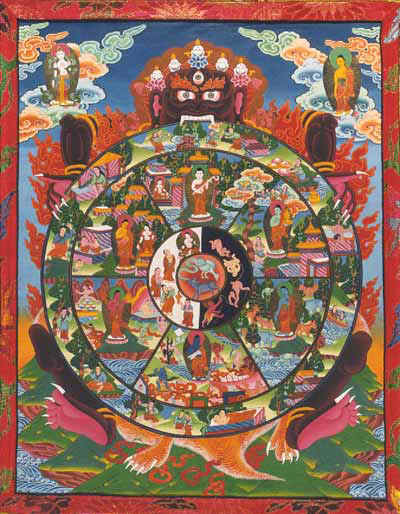
The Wheel of Life (Bhavachakra) is a diagram that portrays the six realms of being. Here, the realm of the Devas is shown at the top, followed clockwise by the realms of the Asuras, the Pretas, Naraka, Animals, and Humans. Note that the Buddha is present in every one of these realms.

Buddhist cosmology posits these six realms as worlds that we are born into. As in many eastern worldviews, there is an essential element of each of us that travels from body to body, transmigrating or reincarnating through many lifetimes. Each time we take on a new body, we are born into one of these six worlds, and when we die, we are reborn into the same or a different world, depending on how much good and bad we have wrought through our actions, words, and thoughts.

Stay with me here, because I am not a believer in reincarnation, but there’s something really useful buried in this model of the Wheel of Life…so first, a brief description of each realm on the Wheel.

The Six Realms
Deva-gati
Asura-gati
Preta-gati
Naraka-gati
Tiryagyoni-gati
Manusya-gati

Deva-gati: realm of blissful beings
These beings are godlike, with wealth, power, long life, and happiness. But they are full of pride and self-satisfaction, and they are blind to the suffering of others, so no compassion or wisdom develops, and thus they do not extend themselves to others. They will be reborn to another realm. Doing good got them to this pleasant place, but they cannot free themselves from the wheel because they are no longer doing good for others.

Asura-gati: realm of the fallen gods
These demi-gods are full of envy and jealousy, because they can see the devas and wish to be in that realm. Since they want to be superior, they belittle others. They live in a more pleasurable situation than humans, but their envy and jealousy keeps them riled up. They got here by intending to do good in the past, but winding up doing harm to others.

Preta-gati: realm of hungry ghosts
These beings are depicted with huge empty stomachs, but pinhole mouths and skinny necks. They are perpetually hungry and thirsty, but cannot ever satisfy those cravings. This is the realm of craving, hunger, addiction, obsession, compulsion.

Naraka-gati: Hell realm
This is the most terrible of the realms. These creatures are angry, aggressive, driving away any who show love or compassion, seeking only other hell beings’ company. The only way out is time—they have planted karmic seeds by hurting others, and those seeds must bear terrible fruit for them to experience, and then they can be reborn to another realm.

Tiryagyoni-gati: animal realm
These creatures are ignorant, prejudiced, and complacent. It is not that they do not know, it is that they mis-know, they are incorrect in their thinking and content to remain that way. They are mostly concerned with avoiding discomfort and have no interest in understanding better, seeing more clearly, or doing good.

Manusya-gati: human realm
This is the only realm from which escape from the wheel of samsara is possible. Enlightenment is at hand…but only a few awaken to it. It is characterized by doubt, desire, but also inquiry and reflection. YOU SEE YOU ARE IMPERFECT, YET YOU DO THE RIGHT THING ANYWAY. You can see others’ suffering and respond with compassion, accruing great karma—which takes so long in any other realm. It is from this realm that you have a chance to jump off the wheel of habit, of doing the same thing over and over, of creating suffering in yourself.

Imagine you grow up hearing of these realms as worlds you inhabit over lifetimes. At the end of each life, your karmic accounting is done and according to its results, you are kicked into one of these realms to work out some more of your s**t. Very useful story for your society, which keeps you working to do good, yes? Pretty useful for you, too, as doing good will help you in the present moment, anyway.

Now imagine you find a teacher who tells you that, in fact, in each moment we are in one of these realms, and in fact, the wheel is constantly turning. These realms are a model for our emotional states as they shift and change over minutes and hours. And we put ourselves there, no one else does it for us. Moment by moment, we make ourselves blissful, envious, endlessly craving, angry, ignorant, doubtful. We do it in the way that we react to what is happening here and now. And in this moment—not in our next lifetime—we have opportunities to transmigrate into a different realm, by changing our response to how things are.

It is hard, to be sure, because our conditioning keeps us doing/saying/thinking the same things. But we always have a chance to change the realm we are in…and when we are in the human realm, of doubt, desire, inquiry, reflection…that is when we have a chance to let go of the whole darn cycle altogether. A chance to stop reacting and just stay aware. Each time we loosen the grip of samsara (conditioning) on our thoughts/words/actions, and perceive a new way of being, we are closer to freedom. It doesn’t take lifetimes. The moment is now.

I love this esoteric interpretation of the Wheel of Life. It doesn’t discount that it may, in fact, take more than one lifetime to really do this work (which I also agree with; I’m just not sure that we’ll get that next lifetime), yet it emphasizes that it starts right NOW. And big things can happen right now.

When the person at work or at home does something that arouses anger, or prompts a feeling of superiority, or even makes me feel happy because of my external circumstances...that's not a bad thing. (Remember, the Buddha is present in each realm!) But can I see that I have put myself into this realm of Hell, or of the Asuras, or of the Devas? Can the dramatization of the Wheel of Life help me find a little distance from the play of emotions on this stage?

We can change the ruts that our wheels have gotten stuck in, gradually creating new paths, and eventually roaming free of roads, paths, and ruts at all. And sometimes our wheels take a big jump off the beaten track! But most often, we have to work at moving this way and that, slowly nudging ourselves into new territory. New ways of moving the body, softening the heart, opening the mind.

Krishnamurti reminds us: “Enlightenment is an accident. But we can do certain things to make ourselves accident-prone.”

You know what those things are. Back to the mat.

(And doesn’t this kind of interpretation make you wonder about western cosmologies and metaphysical stories? The ones with equally unlikely chances at being literally correct, yet ripe with metaphorical possibilities?)

The Guest House

Being human is like a guest house.
Each morning a new arrival.
A joy, a depression, a meanness,
some momentary awareness
comes as an unexpected visitor.

Welcome and entertain them all!

Even if they're a crowd of sorrows,
who violently sweep your house
empty of its furniture,
still treat each guest honorably.

He may be clearing you out for
some new delight.

The dark thought, the shame,
the malice,
meet them at the door laughing,
and invite them in.

Be grateful for whoever comes,
because each has been sent
as a guide from beyond.

--Rumi

When you practice today, watch each thought and feeling. Invite it in. It may be clearing you out for some new delight.

When you interact with clients or customers at work, when you clean the house, when you bump into your neighbor, when you talk to your sibling, when you lie in bed awaiting sleep. Invite it in. Then watch it depart.

09 December 2011

Act now!

Tapas.
Svadhyaya.
Ishvara pranidhana.

Fire it up.
Observe.
Let go.

The three aspects of any practice, on the mat or in the office or at home.

Read all about these in Patanjali's Yoga Sutras, the Hatha Yoga Pradipika, numerous commentaries. So many good translations and explanations and applications...

But then just think about them and apply them in your own practice, moment to moment.

~Passionate self-discipline, driving you to act, even when it is difficult. This gets you up and going, every day, back to your practice. Your work. Your family.
~Calm, steady awareness. Mindfulness. Observing how things are...and also How Things Really Are. This keeps you safe and learning from what you've done, so that your passion doesn't burn you up in your efforts to change things, nor become just a hamster's wheel you step on.
~Giving it up to something bigger than your individual self, or that which you perceive to be an individual self, anyway. This keeps your practice from turning into just another self-improvement project. This can be God, All Other Living Beings, maybe just the one cactus you keep alive on your kitchen shelf. But think about it; as David Foster Wallace reminded us, you'd better choose what you worship, because we all worship something, and the defaults we're offered in this culture today are money, smarts, beauty, sex...things to "get," and can never get enough of to feel truly satisfied, rather than things we already are.

Which ones are you brilliant at? Which do you suck at?

I'm pretty weak in the last one. Don't like to give up control, consider gods and such symbolic of what is true but not credible as literal beings...making it hard to keep in sight what it is that is meaningful. I tend to let tapas (action) get me going and then wait for svadhyaya (study, awareness) to reveal the magic that is buried in the mundane. That can remind me of what it's all for and where to dedicate my practice (ishvara pranidhana).

Bring each of these elements to your mat today. Notice which is hardest for you. Then bring them into the rest of your day...

17 November 2011

How do we begin? The specifics.

We often begin and end our time on the mat in a seated position. Today, try siddhasana, the Adept's Posture, to find your seat. Here is what the Hatha Yoga Pradipika has to say about it:

Press the perineum with the heel of one foot; place the other foot on top [heels stacked]. Having done this, rest the chin on the chest [and lift the chest to the chin]. Remaining still and steady, with the senses controlled, gaze steadily into the eyebrow center; it breaks open the door to liberation. This is called siddhasana [adept's posture].

This is a specific way of sitting cross-legged that encourages all three bandhas (energetic gates) by reminding us to engage the pelvic floor (where the heel touches), the lower abdominals (to sit tall), and the upper back (lifting the chest, shoulders back). The eyes rest on a drishti (gazing point) so the senses turn inwards.

Once the hips are flexible enough, the legs will rest on the floor and you can tuck your toes between each calf and foot to further stabilize. If your legs are not yet resting on the floor when you sit like this, put a block or folded blankets under your sitting bones to elevate your pelvis until your legs can slope downward from your hip sockets toward the floor. If this still leaves the legs tensed, then keep the bottom heel where it is, but lift the top heel and put in in front of the bottom one, instead of on top of it. If the eyes are straining when you direct them toward the eyebrows, then rest them just past the tip of your nose.

Just as moderate diet is the most important of the yamas, and nonviolence, of the niyamas, so the siddhas know that siddhasana is the most important of the asanas.

Siddhasana directs the body to be stable and open, the senses to turn inward. Now you can focus on your breath and how things ARE.

At the beginning of your practice, start your ujjayi breath here and sink your attention into it. Then form your intention and begin to move through the other asanas.

At the end of your practice, let go of your ujjayi here and just watch the breath as it is, taking in all that is in this moment.

12 November 2011

By special request!

The Hatha Yoga Pradipika (the teachings of hatha yoga compiled around 1400 CE) lists in Chapter 1 the six things that stand in the way of the process of yoga:
overeating
overexertion (making one too tired to practice)
talkativeness
adhering to rules (that are societally based, rather than ethically based--don't just "follow the rules" of our time and do what others do)
being in the company of people who are common (focused on acquiring wealth, bodily pleasures, gossiping, etc.)
an unsteady, wavering mind

And six things that bring success in yoga:
enthusiasm
perseverence
discrimination
unshakeable faith
courage
avoiding the company of common people

So, to let go of what's in the first list and cultivate what is in the second list, we are offered ten rules of conduct (yama):
non-violence
truth-telling
non-stealing
continence (using one's energy wisely, directing it in positive ways)
forgiveness
endurance
compassion
humility
moderate diet
cleanliness

And also ten observances (niyama):
austerity (living simply)
contentment
faith in the Supreme (that which is larger than our individual self)
charity
worship of the Supreme (something larger than our individual self)
listening to the recitations of sacred scriptures (the experiences and advice of the mystics and sages and saints who have come before us)
modesty
discerning intellect
repetition of mantra
sacrifice

Phew! Quite comprehensive, and somewhat overlapping. Choose the one that jumped out at you upon first reading. Take it as your intention as you go about your day and do your practice on the mat. Delve into it more deeply--can look at the roots of why and how you can cultivate this quality in each moment? See what happens.

Remember, however, that these are not meant to be attempted in isolation. Hatha yoga is the tradition of starting with the body--moving in vinyasa (flow), holding the asana (postures), breathing consciously (pranayama), cleansing the body (kriya and shatkarma). These ethical practices and qualities emerge more easily and authentically from us when we regularly tune the body in concert with our efforts to direct our thoughts, words, and actions towards higher ground. Forcing "contentment" or "humility" or "charity" can be just as injurious as forcing Triangle Posture or Bound Lotus. Let the practice unfold in you as it must.

Each of the techniques of yoga--those that seem "physical" and those that seem "spiritual" or "ethical"-- reinforces and clarifies the others.

See Swami Muktibodhananda's commentary in the Bihar School of Yoga version of the Hatha Yoga Pradipika for more insight into each of these elements. We will also continue to work with them in classes this month. And let me know how it unfolds!

07 November 2011

What Do You Have to Tell Your Self?

So somebody asked celebrities what advice they'd give to their sixteen-year-old selves. Then they compiled these nuggets of retrospective advice in a book.

I haven't read the book; I just read a few excerpts. Funny, true stuff. But of course we can do this better for ourselves than any famous person can.

So the next time you practice, begin by asking yourself: What would I tell my sixteen-year-old self to make things clearer to them? Think about this; maybe write it down.

Once you've got the ball of self-generated insight and wisdom rolling, ask the more pressing question: In ten/twenty/fifty years, what would you tell your self of today to make things clearer?

That advice is already inside of you. Bring it to the surface and let it guide your practice today, on and off the mat.

13 October 2011

Mystery and Knowing

Recently I heard a This American Life segment featuring a man who couldn't decide on a couch.

I related to this "problem." We recently bought our first couch. Not a futon, not a loveseat...a real couch. Much more money than ever before spent on any furnishing. Much more space occupied by this hulking object. A lot of options to consider. I could relate. I wanted something more special for my money than I had ever gotten in any single object before. (Except my iPhone.) I almost got a blue couch, that's how special and unusual I wanted it to be.

But this guy couldn't decide for about fifteen years.

The segment compared his sofa indecision--his endless magazine perusals, specialist referrals, and returns--to his dating indecision. He was a man without a couch and without a significant other, with dreams of the perfect mate and the perfect lounge space, neither of which had come along just yet.

Which made me think about how we each choose any of the people or objects to whom we offer our time and our space. At a certain point in the research and in the dreaming, we may find someone or something that seems absolutely perfect. We must have it, or die trying. Usually these ones feel a little out of reach.

Or we may find someone or something that seems to work well enough, and is within reach. The couch man seemed to fear that anything he could actually have in his living room wouldn't be all that great. He feared "settling."

But regardless--whether we "settle" for what is within reach or "strive" for something a bit beyond--there hopefully comes the point at which we have the person or the couch in our living room. Whether we did or did not think it was possible, it is here, now. The honeymoon commences.

And as the sheen of newness is dulled, as wear and tear accrues, we have a choice. An even more crucial turning point than the original decision!

We can think that we know all there is to know about this loved one, that he/she/it has become familiar.

Or we can choose to stay aware of the mystery that remains. The ways in which the loved one will surprise us and support us in new and unfamiliar ways as they change over time.

This is actually a lot easier to see with a human being than with a couch, if only we open our eyes!

Dedicate a practice to a loved one who surprises you. Or dedicate it to cultivating the ability to SEE how that loved one can surprise you, can still have mysteries hidden within, and aspects you haven't yet noticed.